Manila Times

Upholding Truth. Empowering the Philippines
Monday, Aug 24, 2026

Strait of Hormuz Reopens Briefly Amid Fragile Middle East Ceasefire as Global Tensions Persist

Strait of Hormuz Reopens Briefly Amid Fragile Middle East Ceasefire as Global Tensions Persist

A fragile ceasefire in the Middle East has triggered a temporary reopening of the strategically vital Strait of Hormuz, offering brief relief to global energy markets — but the situation remains highly volatile, with military tensions, humanitarian crises, and geopolitical uncertainty continuing to escalate.

Temporary Opening of a Critical Global Oil Route

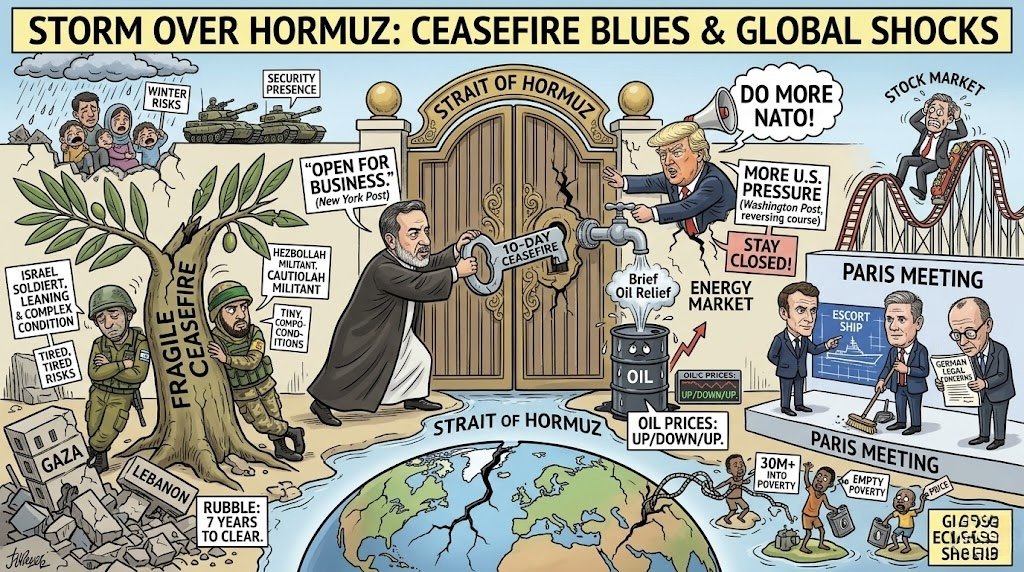
Iran’s Foreign Minister Abbas Araqchi announced that the Strait of Hormuz would remain “completely open for business” during the duration of a newly brokered 10-day ceasefire between Israel and Lebanon. 

The strait — one of the world’s most important maritime chokepoints, carrying roughly a fifth of global oil shipments — had been severely disrupted during weeks of escalating conflict involving Iran, Israel, and the United States. 

Iran stated that commercial vessels could transit via coordinated maritime routes, while international actors began preparing plans to restore secure navigation.

However, optimism proved short-lived. Within days, Iran reversed course and reimposed restrictions on the strait, citing continued U.S. naval pressure and unresolved tensions. 


NATO Allies Prepare Defensive Maritime Mission

As instability around the Strait intensified, a coalition of mainly European and NATO-aligned countries convened in Paris to develop a plan to secure maritime traffic.

The initiative — led by French President Emmanuel Macron and joined by UK Prime Minister Keir Starmer and German Chancellor Friedrich Merz — is expected to include:

  • Military escort vessels
  • Mine-clearing operations
  • Advanced radar and surveillance systems

European leaders emphasized that the mission would be strictly defensive, aimed at ensuring safe passage rather than escalating military involvement.

Germany signaled that its participation would depend on:

  • A sustained ceasefire
  • A multilateral legal framework
  • Potential United Nations authorization

The effort follows pressure from U.S. President Donald Trump, who reportedly urged NATO allies to take a more active role in securing global shipping routes.


Ceasefire Between Israel and Lebanon Offers Limited Relief

The maritime developments are closely tied to a U.S.-brokered 10-day ceasefire between Israel and Lebanon, which came into effect on April 16, 2026. 

The agreement aims to pause hostilities and create space for negotiations after weeks of intense fighting between Israeli forces and Hezbollah.

  • Israel has agreed to halt offensive operations
  • Lebanese authorities are expected to restrain armed groups
  • Hezbollah is not a formal signatory but has signaled conditional compliance

Despite the agreement, tensions remain high:

  • Israel insists it will maintain a security presence in southern Lebanon
  • It reserves the right to carry out preemptive strikes
  • Reports of violations and continued clashes have already emerged

President Trump expressed confidence that all parties — including Hezbollah — would respect the ceasefire, though analysts remain skeptical.


Global Markets React — Then Recoil

The initial announcement of the Strait’s reopening led to:

  • A sharp drop in oil prices
  • Positive movement in global stock markets

But renewed instability quickly reversed market optimism.

Attacks on vessels, military warnings, and conflicting statements from Tehran and Washington have reinforced the perception that the situation remains unpredictable and fragile. 


Humanitarian Crisis Deepens Across the Region

While diplomatic efforts focus on ceasefires and trade routes, the humanitarian toll continues to mount:

Lebanon

  • More than 2,000 deaths reported since the escalation
  • Over 1 million people displaced

Gaza

  • Approximately 90% of the population displaced
  • Around 320,000 buildings damaged or destroyed
  • Severe risks from:
    • Structural collapse
    • Flooding and exposure
    • Unexploded ordnance
    • Toxic debris including asbestos

The United Nations estimates that:

  • Clearing rubble alone could take up to 7 years
  • Full reconstruction may take decades and cost over $40 billion

Winter conditions have further worsened living conditions, with flooding and cold exposure posing life-threatening risks.


Global Economic Fallout Expands

The conflict’s impact is no longer regional.

The United Nations Development Programme warns that ongoing escalation could push more than 30 million people into poverty worldwide, particularly affecting:

  • Sub-Saharan Africa
  • Small island developing states
  • Energy-import-dependent economies

Disruptions to fuel supply chains and rising costs are already being felt globally, reinforcing the broader economic consequences of the crisis.


A Conflict With No Clear Endgame

Despite diplomatic activity, several key issues remain unresolved:

  • The role and disarmament of Hezbollah
  • Israel’s military presence in Lebanon
  • U.S.–Iran tensions and naval confrontations
  • Control and security of the Strait of Hormuz

The ceasefire is widely viewed as temporary and fragile, rather than a definitive step toward peace.


Sum Up

The brief reopening of the Strait of Hormuz offered a glimpse of stabilization in a region under extreme strain — but the rapid reversal underscores a deeper reality:

The Middle East remains on edge, where ceasefires are tentative, alliances are shifting, and the global consequences are immediate.

Even if hostilities pause, the structural damage — humanitarian, economic, and geopolitical — will shape the region and the world for years to come.

AI Disclaimer: An advanced artificial intelligence (AI) system generated the content of this page on its own. This innovative technology conducts extensive research from a variety of reliable sources, performs rigorous fact-checking and verification, cleans up and balances biased or manipulated content, and presents a minimal factual summary that is just enough yet essential for you to function as an informed and educated citizen. Please keep in mind, however, that this system is an evolving technology, and as a result, the article may contain accidental inaccuracies or errors. We urge you to help us improve our site by reporting any inaccuracies you find using the "Contact Us" link at the bottom of this page. Your helpful feedback helps us improve our system and deliver more precise content. When you find an article of interest here, please look for the full and extensive coverage of this topic in traditional news sources, as they are written by professional journalists that we try to support, not replace. We appreciate your understanding and assistance.
Newsletter

Related Articles

0:00
0:00
Close
Swiss Tourist Sentenced to One Year in Prison for Insulting Bali's Sacred Day of Silence
Father Reprimanded After Leaving Seven-Year-Old Son Alone on Mount Fuji During Summit Climb
Google Launches Pixel 11 With Gemini AI at the Center of Its Hardware Strategy
China’s Kimi Launches AI-Focused Credit Card With Agricultural Bank of China and American Express
Success: Nvidia Turned Gaming Chips Into the Engine of the AI Boom
AI’s Next Bottleneck Is Power, Not Just Nvidia Chips
Meta Raises AI Spending Target to as Much as $145bn Despite Pressure Over Returns
Joe Biden’s Cancer Has Spread Beyond His Bones, Hunter Biden Says
Why 2027 Could Be a Strong Year for Stocks—and Why the Forecast Is Fragile
Why Markets May Look Quiet in August After Big Tech Earnings
UFO: Pentagon Releases Video of Unidentified Object Tracked Over Middle East
Ukraine Tells Senate Republicans Its Drone War Offers a Blueprint for America
Weight-Loss Drug Boom Tests the Limits of Prescription Advertising Rules
Taiwan’s President Joins Wartime Command Drill as China Pressure Grows
Lightning Strike Kills Yala FC Player During Match in Southern Thailand
AI Is Remaking the US Economy, From GDP Growth to iPhone Prices
Indonesia’s Free School Meals Plan Has Been Hit by Poisoning, Corruption and Cuts
US and Japan Step In to Support the Yen in Rare Joint Intervention
Valued at $109 Million: F-35B Fighter Jet Crashes in Southern California
US Says It Has Carried Out Heavy Strikes on Iran After Attempted Attacks on Its Forces
Over 24 Hours in the Air: Qantas Airbus Completes Record-Breaking Test Flight
Nvidia Reportedly Takes Vast Texas Data-Centre Lease to Underwrite AI Expansion
FIFA’s Private-Investment Plan for World Cup Rights Draws European Revolt
Following OpenAI's Cyberattack: 'Most Companies Still Do Not Understand What Is Coming'
OpenAI Sued After ChatGPT Allegedly Discouraged Emergency Care Before Near-Fatal Embolism
Miliband Sets Climate and International Law at Centre of UK Diplomacy
Trump Readies New Tariffs as Temporary Global Levy Nears Expiry
EU Imposes Record €550 Million Digital Services Fine on AliExpress
Between Deliveries, Wang Jibing Wrote His Way to China’s Literary Heights
Morgan Stanley Builds a Wall Street Lead in AI Infrastructure Finance
High Prices Push Coffee Drinkers Toward Whole Beans and Home Brewing
Trump Draws Boos and Podium Scrutiny at Spain’s World Cup Triumph
Spain Defeats Argentina in Extra Time to Win Second World Cup
Police Block Cockroach Janta Party’s March to Parliament as Education Protests Intensify
Singapore Considers Lower Taxes for Fund Managers as Hong Kong Intensifies Talent Contest
Proposed U.S.-Saudi Nuclear Pact Could Permit Limited Uranium Enrichment Under International Safeguards
Why Kentucky Fried Chicken Became KFC—and Why the False Explanations Persist
Ukrainian Drones Strike Wildberries Warehouses Deep Inside Russia
Reported CIA Mission Helped Clear the UAE’s Path to Advanced US AI Chips
Artificial Intelligence Capital Fuels Markets While Governments and Regulators Face Mounting Strategic Tests
China’s Moonshot’s Kimi K3 Narrows the Gap With Anthropic Through Scale, Openness and Lower Cost
Gold and Cash Seizure Puts Indonesia’s Senior Anti-Corruption Prosecutor Under Investigation
The Ledger Will Not Trust on Faith
Ukraine’s Leadership Rift Spills Into the Streets as Protesters Target Army Chief
The Ten World Cup Finals That Defined Football History
Smartphones Are Getting More Expensive, Sales Are Collapsing, and Even Apple Admits: "Prices Will Rise"
Leadership Change and Strategic Rivalry Redraw the Political Map
The AI Race Enters Its Infrastructure Era
Britain Nationalises British Steel to Protect Scunthorpe Production and Strategic Supply
French National Assembly Overrides Senate to Pass Historic Assisted-Dying Legislation
×