Manila Times
Upholding Truth. Empowering the Philippines
Monday, Sep 21, 2026
The Nation's Story is Told with Honor

Reported CIA Mission Helped Clear the UAE’s Path to Advanced US AI Chips
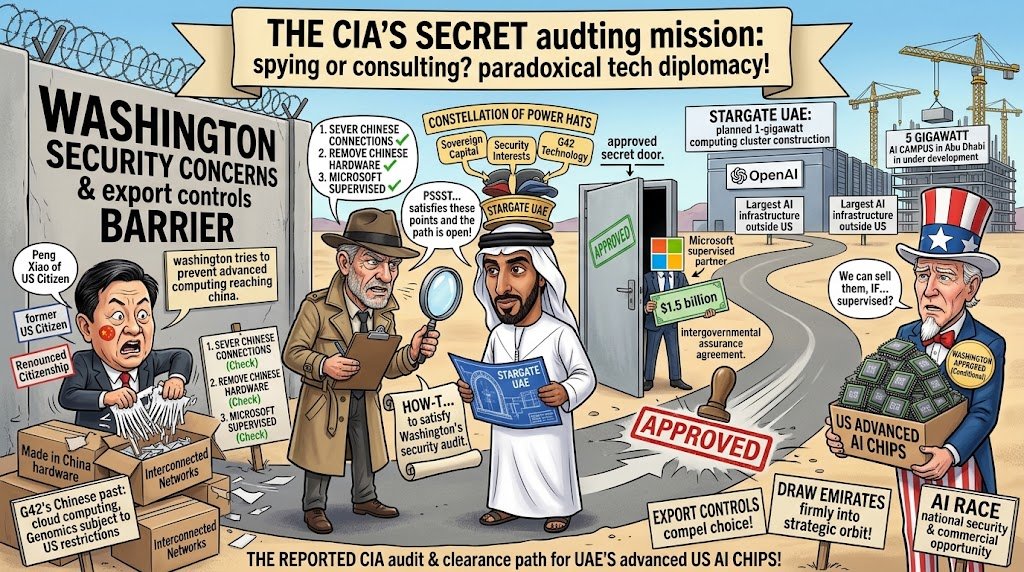
Veteran intelligence officer Jonny Gannon was reportedly sent to investigate G42’s Chinese connections, then helped the Emirati technology group address security concerns that had threatened its access to American computing power.
Jonny Gannon, a veteran Central Intelligence Agency officer, was reportedly sent to Abu Dhabi in 2023 to determine whether the United Arab Emirates and its flagship artificial-intelligence company, G42, could be trusted with some of America’s most sensitive technology.
The assignment placed him inside a contest extending far beyond one company: Washington was trying to prevent advanced computing systems from reaching China, while Abu Dhabi was seeking the processors required to become a global artificial-intelligence centre.
The intelligence agency has not publicly confirmed the operation, its methods or Gannon’s precise instructions.
What is confirmed is that Gannon spent more than 26 years at the agency, became one of its senior executives and retired in the summer of 2025. The reported mission involved examining G42’s leadership, commercial relationships and exposure to Chinese technology while Gannon operated from the US Embassy in Abu Dhabi.
At the centre of the assessment was Sheikh Tahnoon bin Zayed Al Nahyan, the United Arab Emirates’ national security adviser, deputy ruler of Abu Dhabi and chairman of G42.
A brother of President Mohammed bin Zayed Al Nahyan, Tahnoon oversees an unusually broad constellation of sovereign capital, security interests and technology ventures.
That combination of intelligence authority and financial power has made him one of the most consequential figures in the Gulf’s technological ascent.
G42, founded in Abu Dhabi in 2018, had become the principal vehicle for that ambition.
Its businesses span cloud computing, data centres, healthcare, geospatial intelligence and large artificial-intelligence models.
Yet its previous relationships with Chinese companies, including telecommunications and genomics groups subject to American restrictions, unsettled US officials.
Their concern was that advanced American processors, cloud systems or technical knowledge could be diverted to China or exposed through interconnected networks.
Chief executive Peng Xiao attracted particular scrutiny.
Born in China and educated in Hawaii, Xiao became an American citizen and worked as chief technology officer of business-intelligence company MicroStrategy before moving to the Emirates.
He later renounced his US citizenship after becoming an Emirati national.
Before leading G42, he ran an artificial-intelligence operation at DarkMatter, an Emirati cybersecurity company whose surveillance activities generated substantial controversy.
Former American employees of DarkMatter admitted in 2021 that they had supplied sophisticated hacking services to the United Arab Emirates in violation of US export-control and computer-fraud laws.
They agreed to pay more than $1.6 million to resolve the prosecution.
Those proceedings established misconduct by the individuals involved but did not accuse Xiao of a crime.
No allegation that he personally participated in illegal surveillance has been proven.
Gannon’s reported role developed into something more complicated than conventional intelligence collection.
While assessing G42, he also became an intermediary who helped Emirati officials understand the security changes Washington expected.
He established a working relationship with Tahnoon and conveyed American concerns over Chinese hardware, corporate partnerships, data protection and access to strategically important systems.
That dual function—secretly evaluating a partner while helping it satisfy the evaluation—illustrates the tension inside American policy.
One faction regarded the Emirates as a potential conduit through which restricted technology could reach Beijing.
Another argued that denying Abu Dhabi access would push a wealthy and strategically located partner toward Chinese suppliers.
Under that reasoning, selling American technology with enforceable safeguards could provide Washington with greater influence than attempting to isolate the country.
G42 subsequently began severing its Chinese connections and said it had removed Chinese hardware from its operations.
The company adopted a policy barring business with organisations on the US government’s consolidated screening list.
These measures did not erase every concern, but they materially changed the company’s position in Washington.
In April 2024, Microsoft announced a $1.5 billion investment in G42 and secured a seat on its board.
The transaction was accompanied by an intergovernmental assurance agreement covering security, compliance and responsible deployment.
Microsoft and G42 also established continuing compliance reviews, while the Emirati company moved important services onto Microsoft’s cloud platform.
The investment converted an intelligence and diplomatic debate into a closely supervised commercial partnership.
The Biden administration initially considered restrictions that could have placed G42 beyond the reach of advanced American technology.
By January 2025, however, it had established a framework that left a conditional route for approved buyers in the Emirates, although Abu Dhabi regarded the controls as excessively restrictive.
Gannon’s reported intervention contributed to the shift, but it was one element in a wider process involving intelligence assessments, export authorities, diplomats, technology companies and senior officials.
No public evidence establishes that he alone determined the outcome.
President Donald Trump’s administration moved further.
During Trump’s visit to Abu Dhabi in May 2025, the United States and the Emirates announced an artificial-intelligence agreement requiring safeguards against diversion of American technology.
The arrangement supported a five-gigawatt US-Emirati artificial-intelligence campus in Abu Dhabi, described as the largest such infrastructure project outside the United States.
Washington presented the partnership as a way to extend the American technology ecosystem while drawing the Emirates more firmly into its strategic orbit.
The campus includes Stargate UAE, a planned one-gigawatt computing cluster being developed by G42 for OpenAI with Microsoft, Nvidia, Oracle, Cisco and SoftBank among the participating technology groups.
US approval for G42 to receive advanced processors followed in late 2025, allowing the project to move from diplomatic declaration toward deployment.
Construction in Abu Dhabi is now giving physical form to a policy decision once dominated by classified concerns.
The agreement has not eliminated scrutiny.
Advanced artificial-intelligence chips can support civilian research and commercial services, but they can also strengthen surveillance, military analysis and cyber operations.
US officials must therefore verify ownership, physical security, network access, personnel controls and the ultimate users of the computing capacity.
The scale of the project makes continuous enforcement more consequential than assurances issued when the agreement was signed.
Gannon left the agency in 2025 and has since maintained relationships in the Emirates, helping introduce American executives and security contractors to potential partners there.
That work is lawful when conducted within applicable lobbying, export-control and post-government employment rules, but his passage from intelligence officer to private intermediary underscores how closely national security and commercial opportunity now intersect in the artificial-intelligence race.
The episode reveals the operating logic behind Washington’s technology diplomacy.
Export controls are no longer used solely to deny access; they can also compel countries and companies to choose between rival technological ecosystems.
The Emirates responded by reducing its exposure to China, accepting American safeguards and anchoring its largest artificial-intelligence project to US companies.
In return, it secured approved access to the computing power on which its ambitions depend.
The assignment placed him inside a contest extending far beyond one company: Washington was trying to prevent advanced computing systems from reaching China, while Abu Dhabi was seeking the processors required to become a global artificial-intelligence centre.
The intelligence agency has not publicly confirmed the operation, its methods or Gannon’s precise instructions.
What is confirmed is that Gannon spent more than 26 years at the agency, became one of its senior executives and retired in the summer of 2025. The reported mission involved examining G42’s leadership, commercial relationships and exposure to Chinese technology while Gannon operated from the US Embassy in Abu Dhabi.
At the centre of the assessment was Sheikh Tahnoon bin Zayed Al Nahyan, the United Arab Emirates’ national security adviser, deputy ruler of Abu Dhabi and chairman of G42.
A brother of President Mohammed bin Zayed Al Nahyan, Tahnoon oversees an unusually broad constellation of sovereign capital, security interests and technology ventures.
That combination of intelligence authority and financial power has made him one of the most consequential figures in the Gulf’s technological ascent.
G42, founded in Abu Dhabi in 2018, had become the principal vehicle for that ambition.
Its businesses span cloud computing, data centres, healthcare, geospatial intelligence and large artificial-intelligence models.
Yet its previous relationships with Chinese companies, including telecommunications and genomics groups subject to American restrictions, unsettled US officials.
Their concern was that advanced American processors, cloud systems or technical knowledge could be diverted to China or exposed through interconnected networks.
Chief executive Peng Xiao attracted particular scrutiny.
Born in China and educated in Hawaii, Xiao became an American citizen and worked as chief technology officer of business-intelligence company MicroStrategy before moving to the Emirates.
He later renounced his US citizenship after becoming an Emirati national.
Before leading G42, he ran an artificial-intelligence operation at DarkMatter, an Emirati cybersecurity company whose surveillance activities generated substantial controversy.
Former American employees of DarkMatter admitted in 2021 that they had supplied sophisticated hacking services to the United Arab Emirates in violation of US export-control and computer-fraud laws.
They agreed to pay more than $1.6 million to resolve the prosecution.
Those proceedings established misconduct by the individuals involved but did not accuse Xiao of a crime.
No allegation that he personally participated in illegal surveillance has been proven.
Gannon’s reported role developed into something more complicated than conventional intelligence collection.
While assessing G42, he also became an intermediary who helped Emirati officials understand the security changes Washington expected.
He established a working relationship with Tahnoon and conveyed American concerns over Chinese hardware, corporate partnerships, data protection and access to strategically important systems.
That dual function—secretly evaluating a partner while helping it satisfy the evaluation—illustrates the tension inside American policy.
One faction regarded the Emirates as a potential conduit through which restricted technology could reach Beijing.
Another argued that denying Abu Dhabi access would push a wealthy and strategically located partner toward Chinese suppliers.
Under that reasoning, selling American technology with enforceable safeguards could provide Washington with greater influence than attempting to isolate the country.
G42 subsequently began severing its Chinese connections and said it had removed Chinese hardware from its operations.
The company adopted a policy barring business with organisations on the US government’s consolidated screening list.
These measures did not erase every concern, but they materially changed the company’s position in Washington.
In April 2024, Microsoft announced a $1.5 billion investment in G42 and secured a seat on its board.
The transaction was accompanied by an intergovernmental assurance agreement covering security, compliance and responsible deployment.
Microsoft and G42 also established continuing compliance reviews, while the Emirati company moved important services onto Microsoft’s cloud platform.
The investment converted an intelligence and diplomatic debate into a closely supervised commercial partnership.
The Biden administration initially considered restrictions that could have placed G42 beyond the reach of advanced American technology.
By January 2025, however, it had established a framework that left a conditional route for approved buyers in the Emirates, although Abu Dhabi regarded the controls as excessively restrictive.
Gannon’s reported intervention contributed to the shift, but it was one element in a wider process involving intelligence assessments, export authorities, diplomats, technology companies and senior officials.
No public evidence establishes that he alone determined the outcome.
President Donald Trump’s administration moved further.
During Trump’s visit to Abu Dhabi in May 2025, the United States and the Emirates announced an artificial-intelligence agreement requiring safeguards against diversion of American technology.
The arrangement supported a five-gigawatt US-Emirati artificial-intelligence campus in Abu Dhabi, described as the largest such infrastructure project outside the United States.
Washington presented the partnership as a way to extend the American technology ecosystem while drawing the Emirates more firmly into its strategic orbit.
The campus includes Stargate UAE, a planned one-gigawatt computing cluster being developed by G42 for OpenAI with Microsoft, Nvidia, Oracle, Cisco and SoftBank among the participating technology groups.
US approval for G42 to receive advanced processors followed in late 2025, allowing the project to move from diplomatic declaration toward deployment.
Construction in Abu Dhabi is now giving physical form to a policy decision once dominated by classified concerns.
The agreement has not eliminated scrutiny.
Advanced artificial-intelligence chips can support civilian research and commercial services, but they can also strengthen surveillance, military analysis and cyber operations.
US officials must therefore verify ownership, physical security, network access, personnel controls and the ultimate users of the computing capacity.
The scale of the project makes continuous enforcement more consequential than assurances issued when the agreement was signed.
Gannon left the agency in 2025 and has since maintained relationships in the Emirates, helping introduce American executives and security contractors to potential partners there.
That work is lawful when conducted within applicable lobbying, export-control and post-government employment rules, but his passage from intelligence officer to private intermediary underscores how closely national security and commercial opportunity now intersect in the artificial-intelligence race.
The episode reveals the operating logic behind Washington’s technology diplomacy.
Export controls are no longer used solely to deny access; they can also compel countries and companies to choose between rival technological ecosystems.
The Emirates responded by reducing its exposure to China, accepting American safeguards and anchoring its largest artificial-intelligence project to US companies.
In return, it secured approved access to the computing power on which its ambitions depend.
AI Disclaimer: An advanced artificial intelligence (AI) system generated the content of this page on its own. This innovative technology conducts extensive research from a variety of reliable sources, performs rigorous fact-checking and verification, cleans up and balances biased or manipulated content, and presents a minimal factual summary that is just enough yet essential for you to function as an informed and educated citizen. Please keep in mind, however, that this system is an evolving technology, and as a result, the article may contain accidental inaccuracies or errors. We urge you to help us improve our site by reporting any inaccuracies you find using the "Contact Us" link at the bottom of this page. Your helpful feedback helps us improve our system and deliver more precise content. When you find an article of interest here, please look for the full and extensive coverage of this topic in traditional news sources, as they are written by professional journalists that we try to support, not replace. We appreciate your understanding and assistance.