Manila Times
Upholding Truth. Empowering the Philippines
Monday, Oct 05, 2026
The Nation's Story is Told with Honor

Morgan Stanley Builds a Wall Street Lead in AI Infrastructure Finance
Hybrid bonds, private-credit vehicles and chip-backed loans have placed the bank at the center of a data-center investment cycle increasingly funded through debt.
Morgan Stanley has become a principal architect of the debt structures financing the artificial-intelligence infrastructure boom, connecting technology companies and data-center developers with insurers, pension funds, asset managers and private-credit investors.
Its bankers have arranged or advised on tens of billions of dollars in transactions spanning construction, computing chips and the vast facilities required to operate them.
The strategy addresses a central problem confronting the industry.
Artificial-intelligence systems require immense quantities of computing power, electricity and physical infrastructure, but even the largest technology groups cannot fund every project solely from current cash flow without constraining other spending.
Conventional project loans can also be slow, restrictive and difficult to scale to campuses costing tens of billions of dollars.
Morgan Stanley’s answer has been to combine elements of project finance, corporate credit and tradable securities.
Long-term data-center leases and commitments from large technology companies are used to strengthen the credit behind a project.
The resulting debt can then be sold to a broader group of institutional investors, widening the available pool of capital and reducing the amount banks must retain on their own balance sheets.
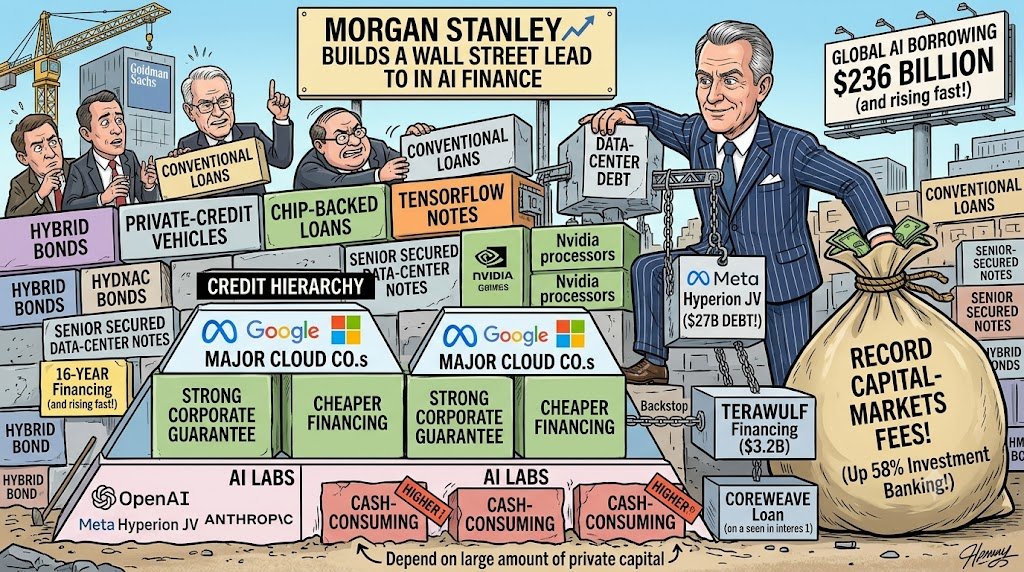
A $3.2 billion financing for data-center developer TeraWulf became an important template.
A subsidiary issued senior secured notes carrying a 7.75 percent coupon and maturing in 2030. The structure incorporated protections normally found in project lending while producing bonds that could be distributed widely.
Google supplied a financial backstop linked to the underlying computing agreements, giving investors exposure to stronger credit support than TeraWulf could have provided alone.
Most of the relevant capacity is intended to serve artificial-intelligence workloads through infrastructure provider Fluidstack, with Anthropic expected to be a major user.
The arrangement illustrates how several companies can occupy different layers of one financing: the developer supplies the site and power, an infrastructure operator contracts for capacity, an artificial-intelligence laboratory consumes the computing resources, and a large technology group supports the commercial obligations.
The stronger the corporate guarantee, the cheaper the financing can become.
Investors assessing a project backed by Google, Meta, Microsoft or another highly rated technology company are not relying exclusively on the balance sheet of a specialized developer.
Industry estimates indicate that a robust guarantee can reduce borrowing costs by roughly half compared with an otherwise similar transaction supported by a weaker counterparty.
Morgan Stanley also advised Meta on the financing of its Hyperion data-center campus in Louisiana, one of the largest private infrastructure transactions assembled for artificial intelligence.
The structure placed the project in a joint venture controlled 80 percent by funds managed by Blue Owl Capital, while Meta retained 20 percent.
More than $27 billion of debt and additional equity were raised through the arrangement, with Meta acting as developer, operator and long-term tenant.
That transaction allowed the project vehicle, rather than Meta itself, to incur the construction debt.
Meta nevertheless provided substantial support, including lease commitments and a conditional residual-value guarantee covering the first 16 years of operation.
The protections helped the private debt secure an investment-grade rating while transferring ownership and financing risk among Meta, Blue Owl and institutional bondholders.
The bank has extended the approach from buildings to the processors installed inside them.
It arranged an $8.5 billion financing for CoreWeave, a cloud provider specializing in graphics-processing capacity, supported by a contract with a large technology customer.
Morgan Stanley and Japanese lender MUFG subsequently assembled a $3.1 billion syndicated term loan to finance the purchase and installation of Nvidia processors.
Investor demand for the latter transaction reached approximately $20 billion.
The loan, however, carried a substantially larger premium over benchmark rates because its underlying customers were artificial-intelligence laboratories rather than technology groups with more established balance sheets.
The contrast exposes the credit hierarchy forming inside the sector: debt supported by major cloud companies is comparatively inexpensive, while financing dependent on cash-consuming laboratories commands higher returns.
Morgan Stanley has also advised Broadcom on a roughly $35 billion chip-financing transaction.
Taken together, the deals show how artificial intelligence is developing a specialized credit market encompassing property, power infrastructure, construction contracts, semiconductors and long-term computing leases.
The expansion has strengthened Morgan Stanley’s position in capital markets.
The bank generated $2.3 billion in debt and equity capital-markets fees during the first half of 2026, up from $1.4 billion in the same period a year earlier.
It rose from fourth to second globally in those fee rankings, behind JPMorgan Chase and ahead of Goldman Sachs.
Morgan Stanley reported record net revenue of $21.3 billion for the second quarter, compared with $16.8 billion a year earlier.
Investment-banking revenue increased 58 percent, although the bank does not separately disclose how much of that growth came directly from artificial-intelligence infrastructure transactions.
The financing boom carries risks alongside its fees.
Data centers face construction delays, power shortages and rapidly changing technology, while graphics processors can depreciate quickly as newer models enter the market.
Some projects ultimately depend on laboratories such as OpenAI and Anthropic, whose spending requirements remain high despite their ability to attract large amounts of private capital.
A downturn in demand, the failure of a tenant or a reduction in financial support from a major technology company could weaken several linked layers of debt.
The market is nevertheless expanding at exceptional speed.
Global borrowing associated with artificial intelligence had reached about $236 billion by the end of May 2026, roughly four times the amount recorded over the comparable period a year earlier, and Morgan Stanley projects issuance could approach $570 billion for the full year.
Having sold more than $40 billion of the emerging construction instruments, the bank is now working to extend the model into European and Asian markets.
Its bankers have arranged or advised on tens of billions of dollars in transactions spanning construction, computing chips and the vast facilities required to operate them.
The strategy addresses a central problem confronting the industry.
Artificial-intelligence systems require immense quantities of computing power, electricity and physical infrastructure, but even the largest technology groups cannot fund every project solely from current cash flow without constraining other spending.
Conventional project loans can also be slow, restrictive and difficult to scale to campuses costing tens of billions of dollars.
Morgan Stanley’s answer has been to combine elements of project finance, corporate credit and tradable securities.
Long-term data-center leases and commitments from large technology companies are used to strengthen the credit behind a project.
The resulting debt can then be sold to a broader group of institutional investors, widening the available pool of capital and reducing the amount banks must retain on their own balance sheets.
A $3.2 billion financing for data-center developer TeraWulf became an important template.
A subsidiary issued senior secured notes carrying a 7.75 percent coupon and maturing in 2030. The structure incorporated protections normally found in project lending while producing bonds that could be distributed widely.
Google supplied a financial backstop linked to the underlying computing agreements, giving investors exposure to stronger credit support than TeraWulf could have provided alone.
Most of the relevant capacity is intended to serve artificial-intelligence workloads through infrastructure provider Fluidstack, with Anthropic expected to be a major user.
The arrangement illustrates how several companies can occupy different layers of one financing: the developer supplies the site and power, an infrastructure operator contracts for capacity, an artificial-intelligence laboratory consumes the computing resources, and a large technology group supports the commercial obligations.
The stronger the corporate guarantee, the cheaper the financing can become.
Investors assessing a project backed by Google, Meta, Microsoft or another highly rated technology company are not relying exclusively on the balance sheet of a specialized developer.
Industry estimates indicate that a robust guarantee can reduce borrowing costs by roughly half compared with an otherwise similar transaction supported by a weaker counterparty.
Morgan Stanley also advised Meta on the financing of its Hyperion data-center campus in Louisiana, one of the largest private infrastructure transactions assembled for artificial intelligence.
The structure placed the project in a joint venture controlled 80 percent by funds managed by Blue Owl Capital, while Meta retained 20 percent.
More than $27 billion of debt and additional equity were raised through the arrangement, with Meta acting as developer, operator and long-term tenant.
That transaction allowed the project vehicle, rather than Meta itself, to incur the construction debt.
Meta nevertheless provided substantial support, including lease commitments and a conditional residual-value guarantee covering the first 16 years of operation.
The protections helped the private debt secure an investment-grade rating while transferring ownership and financing risk among Meta, Blue Owl and institutional bondholders.
The bank has extended the approach from buildings to the processors installed inside them.
It arranged an $8.5 billion financing for CoreWeave, a cloud provider specializing in graphics-processing capacity, supported by a contract with a large technology customer.
Morgan Stanley and Japanese lender MUFG subsequently assembled a $3.1 billion syndicated term loan to finance the purchase and installation of Nvidia processors.
Investor demand for the latter transaction reached approximately $20 billion.
The loan, however, carried a substantially larger premium over benchmark rates because its underlying customers were artificial-intelligence laboratories rather than technology groups with more established balance sheets.
The contrast exposes the credit hierarchy forming inside the sector: debt supported by major cloud companies is comparatively inexpensive, while financing dependent on cash-consuming laboratories commands higher returns.
Morgan Stanley has also advised Broadcom on a roughly $35 billion chip-financing transaction.
Taken together, the deals show how artificial intelligence is developing a specialized credit market encompassing property, power infrastructure, construction contracts, semiconductors and long-term computing leases.
The expansion has strengthened Morgan Stanley’s position in capital markets.
The bank generated $2.3 billion in debt and equity capital-markets fees during the first half of 2026, up from $1.4 billion in the same period a year earlier.
It rose from fourth to second globally in those fee rankings, behind JPMorgan Chase and ahead of Goldman Sachs.
Morgan Stanley reported record net revenue of $21.3 billion for the second quarter, compared with $16.8 billion a year earlier.
Investment-banking revenue increased 58 percent, although the bank does not separately disclose how much of that growth came directly from artificial-intelligence infrastructure transactions.
The financing boom carries risks alongside its fees.
Data centers face construction delays, power shortages and rapidly changing technology, while graphics processors can depreciate quickly as newer models enter the market.
Some projects ultimately depend on laboratories such as OpenAI and Anthropic, whose spending requirements remain high despite their ability to attract large amounts of private capital.
A downturn in demand, the failure of a tenant or a reduction in financial support from a major technology company could weaken several linked layers of debt.
The market is nevertheless expanding at exceptional speed.
Global borrowing associated with artificial intelligence had reached about $236 billion by the end of May 2026, roughly four times the amount recorded over the comparable period a year earlier, and Morgan Stanley projects issuance could approach $570 billion for the full year.
Having sold more than $40 billion of the emerging construction instruments, the bank is now working to extend the model into European and Asian markets.
AI Disclaimer: An advanced artificial intelligence (AI) system generated the content of this page on its own. This innovative technology conducts extensive research from a variety of reliable sources, performs rigorous fact-checking and verification, cleans up and balances biased or manipulated content, and presents a minimal factual summary that is just enough yet essential for you to function as an informed and educated citizen. Please keep in mind, however, that this system is an evolving technology, and as a result, the article may contain accidental inaccuracies or errors. We urge you to help us improve our site by reporting any inaccuracies you find using the "Contact Us" link at the bottom of this page. Your helpful feedback helps us improve our system and deliver more precise content. When you find an article of interest here, please look for the full and extensive coverage of this topic in traditional news sources, as they are written by professional journalists that we try to support, not replace. We appreciate your understanding and assistance.