Manila Times
Upholding Truth. Empowering the Philippines
Thursday, Jul 30, 2026
The Nation's Story is Told with Honor

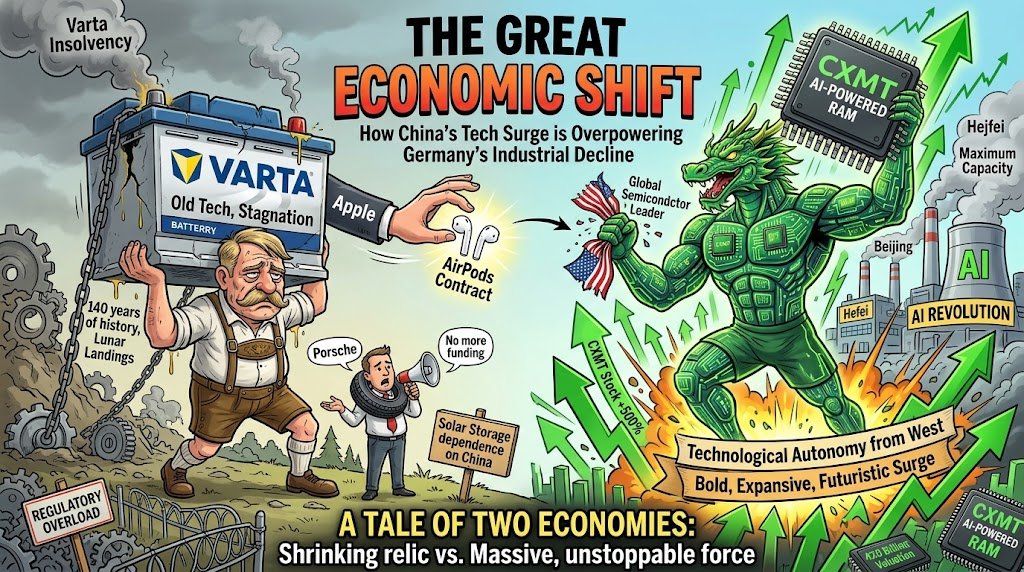
The Great Economic Shift: How China's Tech Surge is Overpowering Germany's Industrial Decline
As the historic German battery giant Varta files for insolvency following the loss of key Apple contracts, China's CXMT achieves a meteoric stock market debut, signaling a massive global pivot in semiconductor leadership.
A profound economic divergence is unfolding between two industrial titans, representing much more than mere corporate fluctuations.
It is a tale of two economies: a shrinking, highly regulated, and stagnant German landscape versus an expansive, bold, and futuristic Chinese surge.
Varta, a venerable German institution with nearly 140 years of history—whose products once powered polar expeditions and even the first lunar landings—has filed for insolvency proceedings in Stuttgart.
While not yet unable to meet immediate obligations, the company faces a liquidity crisis projected toward 2027. The downfall is driven by volatile market conditions, currency fluctuations, and, most critically, the termination of a vital contract with Apple.
The American tech giant has shifted its AirPods battery procurement to Chinese suppliers.
Varta’s shareholders, including Porsche, have indicated they will not provide further funding.
While the company's domestic battery division may undergo restructuring to survive as a separate entity, the fate of its other divisions remains uncertain.
This collapse threatens Germany's solar storage market and deepens the nation's technological dependence on China.
In stark contrast, China's CXMT has achieved a historic market debut on the Shanghai exchange.
Founded in 2016 by Joe Yiming—who envisioned the migration of the memory chip industry from the United States to Japan, then Korea, and finally China—the company is now the world's fourth-largest producer of RAM.
Upon its first day of trading, CXMT's stock price surged by over 500%, driving its valuation to an estimated 420 billion euros, making it China's most valuable publicly traded company.
CXMT’s success is not necessarily rooted in technological superiority; its chips are arguably generations behind Western competitors due to U.S. export sanctions.
Instead, the triumph lies in timing and scale.
As the Artificial Intelligence revolution creates an insatiable global demand for short-term memory, CXMT's factories in Hefei and Beijing are operating at maximum capacity, supplying giants like Xiaomi and Alibaba.
After posting a 3 billion dollar loss in 2023, CXMT turned profitable in 2025, with first-quarter 2026 revenues exceeding 7.5 billion dollars.
This meteoric rise reflects China's broader geopolitical imperative: achieving total economic and technological autonomy from the West to ensure supremacy in the era of Artificial Intelligence.
It is a tale of two economies: a shrinking, highly regulated, and stagnant German landscape versus an expansive, bold, and futuristic Chinese surge.
Varta, a venerable German institution with nearly 140 years of history—whose products once powered polar expeditions and even the first lunar landings—has filed for insolvency proceedings in Stuttgart.
While not yet unable to meet immediate obligations, the company faces a liquidity crisis projected toward 2027. The downfall is driven by volatile market conditions, currency fluctuations, and, most critically, the termination of a vital contract with Apple.
The American tech giant has shifted its AirPods battery procurement to Chinese suppliers.
Varta’s shareholders, including Porsche, have indicated they will not provide further funding.
While the company's domestic battery division may undergo restructuring to survive as a separate entity, the fate of its other divisions remains uncertain.
This collapse threatens Germany's solar storage market and deepens the nation's technological dependence on China.
In stark contrast, China's CXMT has achieved a historic market debut on the Shanghai exchange.
Founded in 2016 by Joe Yiming—who envisioned the migration of the memory chip industry from the United States to Japan, then Korea, and finally China—the company is now the world's fourth-largest producer of RAM.
Upon its first day of trading, CXMT's stock price surged by over 500%, driving its valuation to an estimated 420 billion euros, making it China's most valuable publicly traded company.
CXMT’s success is not necessarily rooted in technological superiority; its chips are arguably generations behind Western competitors due to U.S. export sanctions.
Instead, the triumph lies in timing and scale.
As the Artificial Intelligence revolution creates an insatiable global demand for short-term memory, CXMT's factories in Hefei and Beijing are operating at maximum capacity, supplying giants like Xiaomi and Alibaba.
After posting a 3 billion dollar loss in 2023, CXMT turned profitable in 2025, with first-quarter 2026 revenues exceeding 7.5 billion dollars.
This meteoric rise reflects China's broader geopolitical imperative: achieving total economic and technological autonomy from the West to ensure supremacy in the era of Artificial Intelligence.
AI Disclaimer: An advanced artificial intelligence (AI) system generated the content of this page on its own. This innovative technology conducts extensive research from a variety of reliable sources, performs rigorous fact-checking and verification, cleans up and balances biased or manipulated content, and presents a minimal factual summary that is just enough yet essential for you to function as an informed and educated citizen. Please keep in mind, however, that this system is an evolving technology, and as a result, the article may contain accidental inaccuracies or errors. We urge you to help us improve our site by reporting any inaccuracies you find using the "Contact Us" link at the bottom of this page. Your helpful feedback helps us improve our system and deliver more precise content. When you find an article of interest here, please look for the full and extensive coverage of this topic in traditional news sources, as they are written by professional journalists that we try to support, not replace. We appreciate your understanding and assistance.